

Principal Investigator: Prof. Nicodemus Govella
Project leader/ Coordinator: Dr. Tegemeo Gavana
Project Administrator: Felix Brown
Funding Partner: World Health Orgnization
Start date: June 1, 2026
End date: Feb. 28, 2028
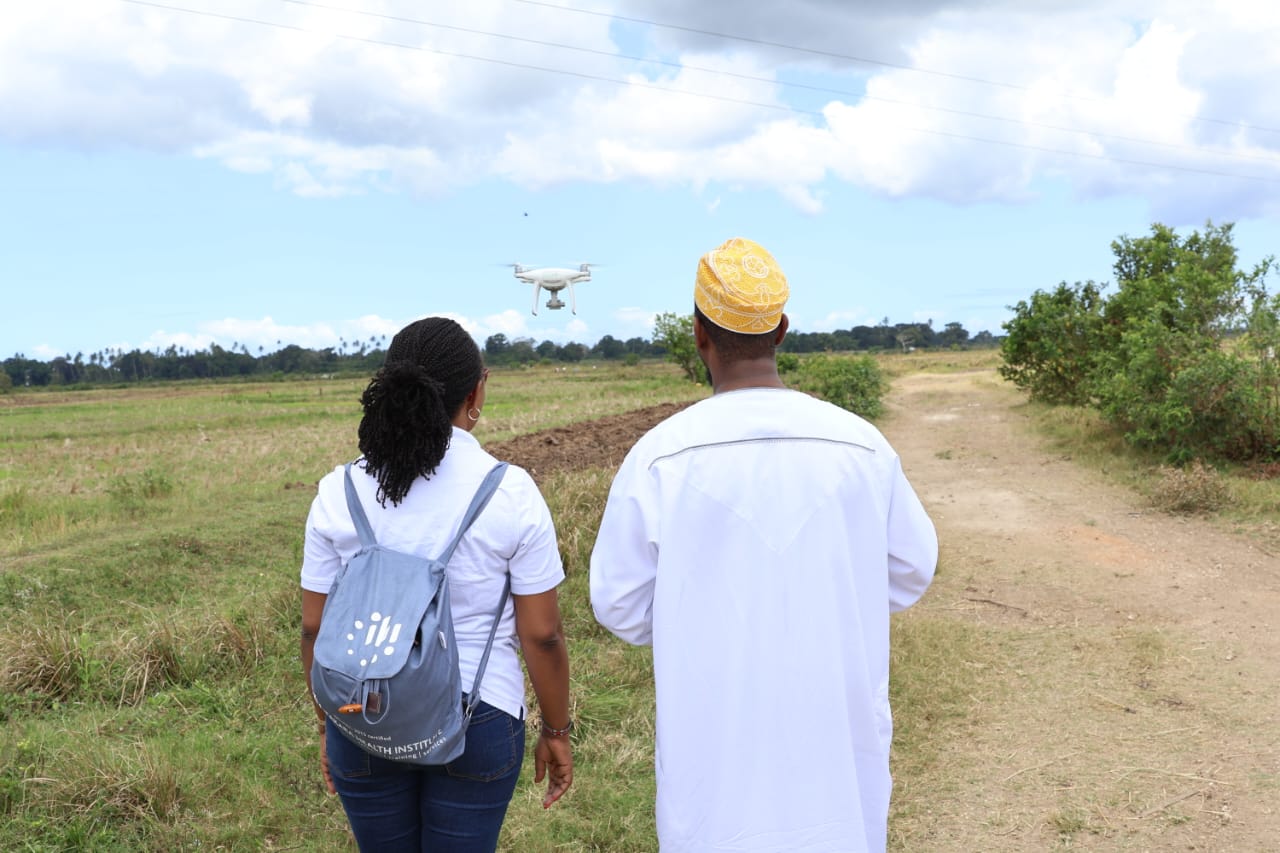
Smart Drone Technology for a Malaria-Free Future in Zanzibar
Zanzibar has made significant progress towards malaria elimination, reducing malaria prevalence to below 1% between 2006 and 2008. However, sustaining these gains remains challenging, with recurrent malaria outbreaks reported since 2023.
Malaria transmission in Zanzibar is influenced by several factors, including population movement between Zanzibar and high-transmission areas, mosquito vectors that increasingly bite outdoors, and growing insecticide resistance that can reduce the effectiveness of indoor interventions such as insecticide-treated nets and indoor residual spraying.
To address these challenges, Zanzibar has included larval source management (LSM)—the identification and treatment of mosquito breeding sites—as a complementary intervention in its malaria elimination strategy. However, conventional LSM relies heavily on ground-based teams to locate and treat larval habitats, making the process labour-intensive, costly and potentially prone to inaccuracies.
The Smart Drone Technology for a Malaria-Free Future in Zanzibar project will evaluate an innovative approach that combines drones and artificial intelligence (AI) to identify, map and classify potential mosquito larval habitats and support more efficient larvicide delivery.
The initiative was officially launched in Zanzibar in May 2026 through a collaboration between the Zanzibar Malaria Elimination Programme (ZAMEP), WHO Tanzania, SORA Technology and the Ifakara Health Institute (IHI).
The Innovation
The project will evaluate SORA Technology’s drone- and AI-powered system, which is designed to help malaria control teams:
Rapidly map potential mosquito larval habitats at high resolution.
Identify and classify high-risk larval habitats.
Generate GPS-guided routes for spray teams to locate and treat identified sites.
Improve access to hard-to-reach breeding areas.
Reduce the time and resources required for larval source management.
Generate real-time geospatial information to support surveillance, planning and monitoring.
By combining aerial imagery, artificial intelligence and geospatial data, the approach could help malaria control teams move from labour-intensive mapping towards faster, more targeted and data-driven larval source management.
Project Objectives
General objective
To assess the feasibility, operational efficiency and cost-effectiveness of an innovative AI-powered drone-based approach to larval source management and its potential contribution to malaria elimination efforts in Zanzibar.
Primary objectives
The project will:
Assess the feasibility of using drone-based AI to map and classify potential Anopheles larval habitats.
Compare the operational efficiency of drone-based AI and conventional approaches, including mapping time, manpower requirements and the amount of larvicide used.
Assess the reduction in positive larval habitats achieved through drone-based and conventional larval source management.
Assess the acceptability of drone-based larval source management compared with conventional approaches.
Secondary objectives
The project will also:
Compare trends in human biting exposure, based on adult mosquito sampling, between areas using drone-based and conventional larval source management.
Compare malaria incidence between areas implementing drone-based larval source management and those using conventional approaches.
Expected Impact
The project will generate evidence on whether drone and AI technologies can make larval source management faster, more accurate, targeted and cost-effective.
If successful, the approach could strengthen Zanzibar’s malaria surveillance and vector control efforts by helping teams identify high-risk breeding habitats more efficiently, reach difficult areas and target larvicide applications where they are most needed.
The evidence generated will help inform decisions on the potential integration and scale-up of innovative technology-based larval source management as Zanzibar works towards a malaria-free future.
Partners
The project brings together expertise from national and international partners:
World Health Organization (WHO) Tanzania: Prime grant recipient and technical oversight.
Zanzibar Malaria Elimination Programme (ZAMEP): Host institution, supporting mapping, data systems, entomology and evaluation activities.
SORA Technology: Provides drone mapping and imagery analysis technologies.
Ifakara Health Institute (IHI): Provides expertise in vector control, entomological surveillance and operational research.
IHI’s contribution is led by Prof. Nico Govella, Senior Entomologist and Principal Investigator, and Dr. Tegemeo Gavana, Entomologist and Project Leader, with Dr. Irene Moshi leading the social science and process evaluation component and Mr. Felix Brown supporting project administration. IHI’s role builds on its expertise in vector control and entomological research in Tanzania.
Project Duration
June 2026 – February 2028
We're a Registered Charity Organization in Tanzania
Ifakara Health Institute (IHI) is officially recognized as a charitable organization under the Income Tax Act. Certification issued on 20 March 2025 and valid until 31 December 2030.
Ifakara Health Institute (IHI) is officially recognized as a charitable organization under the Income Tax Act. Certification issued on 20 March 2025 and valid until 31 December 2030.